Controlling weed in the orchard
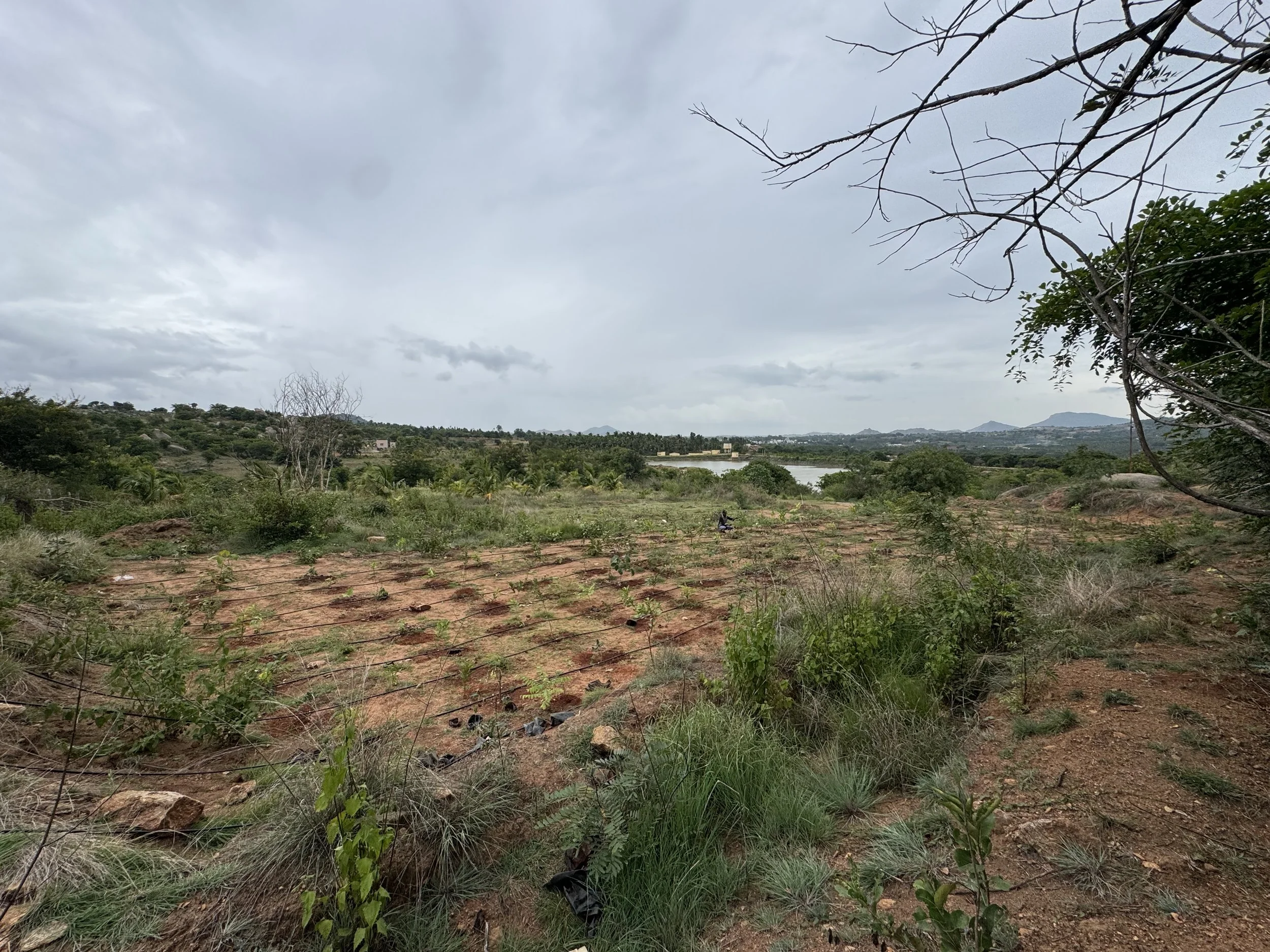
As the monsoon ends, our biggest challenge has been a sea of overgrown grass. We immediately faced a dilemma: our farmer friends advised tilling, but the Indian and Japanese natural farming principles we follow advise against it to protect soil life. We truly value this ground cover for aerating soil and attracting beneficial insects. But a practical balance was essential. A fruit orchard with 4-foot grass is unmanageable and a genuine safety hazard, offering ideal cover for snakes. We couldn't risk someone accidentally stepping on one.
Our first attempt, brush cutters, aligned with our principles by mulching the soil, but it was overwhelmingly slow. Clearing our 5 acres would take an estimated 3 months, an impossible timeframe. We were constantly behind. That’s when we came across a stubble mower, which brought the clearing time down to about two weeks.
We want to be open: this was a compromise we wrestled with. A fuel-powered machine isn't perfectly aligned with Fukuoka’s principles or our renewable energy goals. But it's the 'best-fit' solution we've found. Crucially, it avoids tilling (our main concern) and mulches everything, returning all that organic matter to the soil. It's the most workable compromise between our ideals and on-the-ground reality, especially as effective electric mowers aren't available in India.
This is all a learning process for us. We found our mower at Raithra Mane in Tumkur. We're happy to share our experience, so please feel free to ping us at +919677201088. And honestly, if you know of any effective electric stubble mowers, we would be genuinely grateful to hear about them!
How we deal with pests/disease the organic way
It was bound to happen. Sooner or later on any farm, the pests come knocking. For us, with our deep commitment to 100% natural and organic farming, reaching for a chemical spray was never an option. So, how do we prepare for the inevitable?
The answer came from a conversation that completely changed how we see our trees. Early in our journey, we met a fellow farmer who asked us a simple question: “When do you or your family get sick?”
“When our immune system is weak,” we answered.
“Exactly,” he said. “And how do you strengthen it?”
“By eating healthy, exercising, and resting,” we replied.
He smiled. “It’s the exact same for trees. Stop thinking about killing pests and start thinking about building the tree’s own immune system. Give it great nutrition and a healthy environment, and it will learn to defend itself.”
That conversation was a lightning bolt. We have seen endless cycle of chemical treatments in conventional farming. In a typical mango orchard: chemical is sprayed when the flowers appear, another when the fruit sets, another to fight fungus, and yet another to ripen or preserve it. You get a huge harvest, sure, but is that what you really want to feed your kids?
We didn't. So we got to work building our farm's "immune system." We developed a health regimen for our trees based on their age:
For the "toddlers" (< 2 years): A nourishing dose of Jeevamruth and organic manure every two weeks.
For the "teenagers" (2-8 years): A booster shot of organic manure every two months.
For the "adults" (> 8 years): An annual health check-up and a shot of organic manure.
To ward off infections, especially during the wet monsoon months, we spread neem cake powder around their bases every six months. We also gave the younger trees a protective spray of neem oil every month or two based on age.
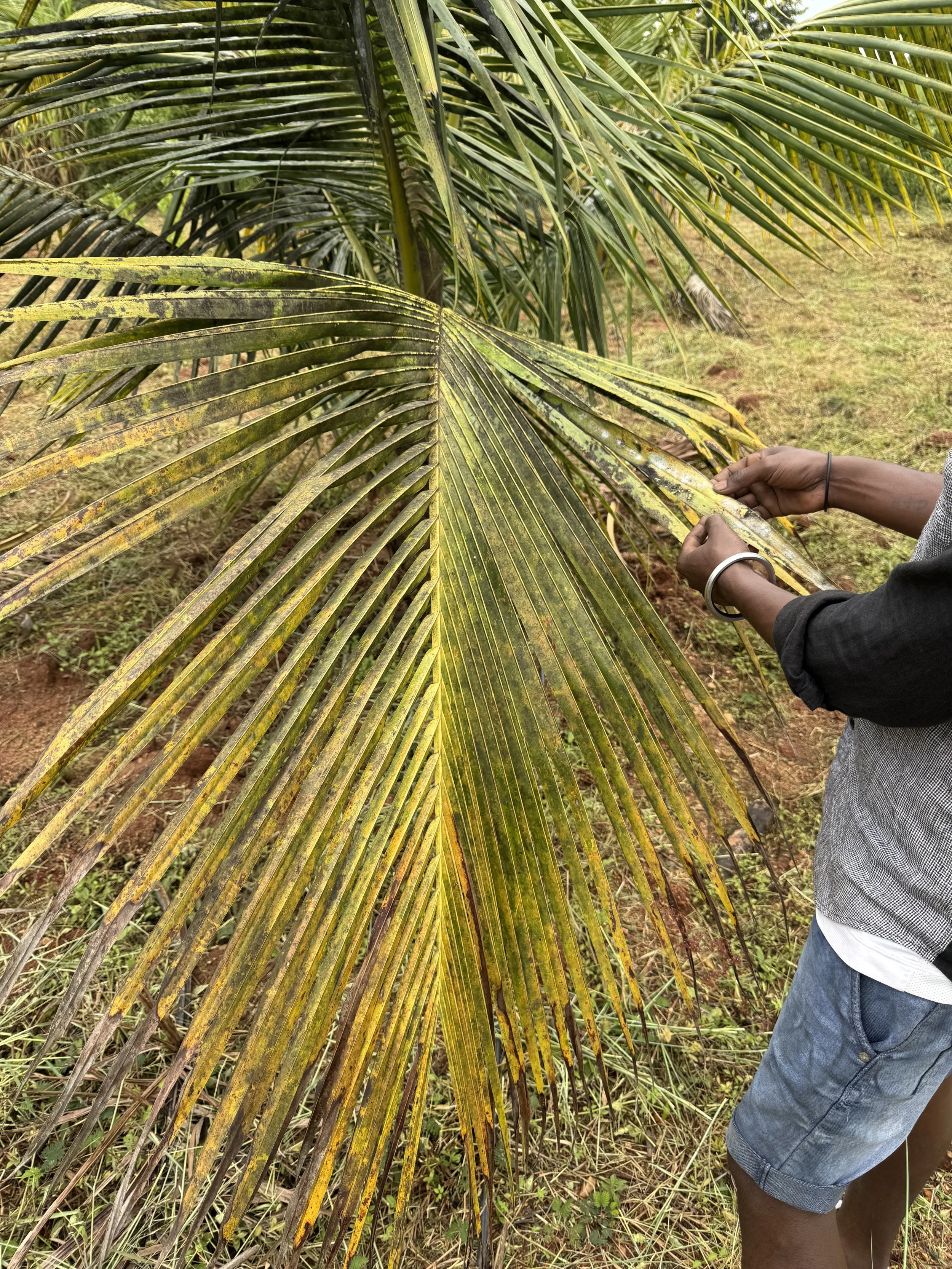
But nature always has a test for you. Despite our best efforts, we got an infestation of the formidable-sounding Rhinoceros Beetle. These pests can devastate young trees with alarming speed. While our neem oil routine was helping, we needed to be more aggressive.
Instead of declaring chemical warfare, we deployed special pheromone traps that lure the beetles in, preventing them from ever reaching our precious trees. This strategy has already dramatically reduced the damage, and we’re confident we can get it under control in the coming months. It’s a constant process of learning and adapting, but one that lets us sleep at night.
The traps need to be replaced every three months, and we're carefully monitoring the results. Stay tuned to see how our battle of wits against the beetle goes!
Is it just a coincidence!
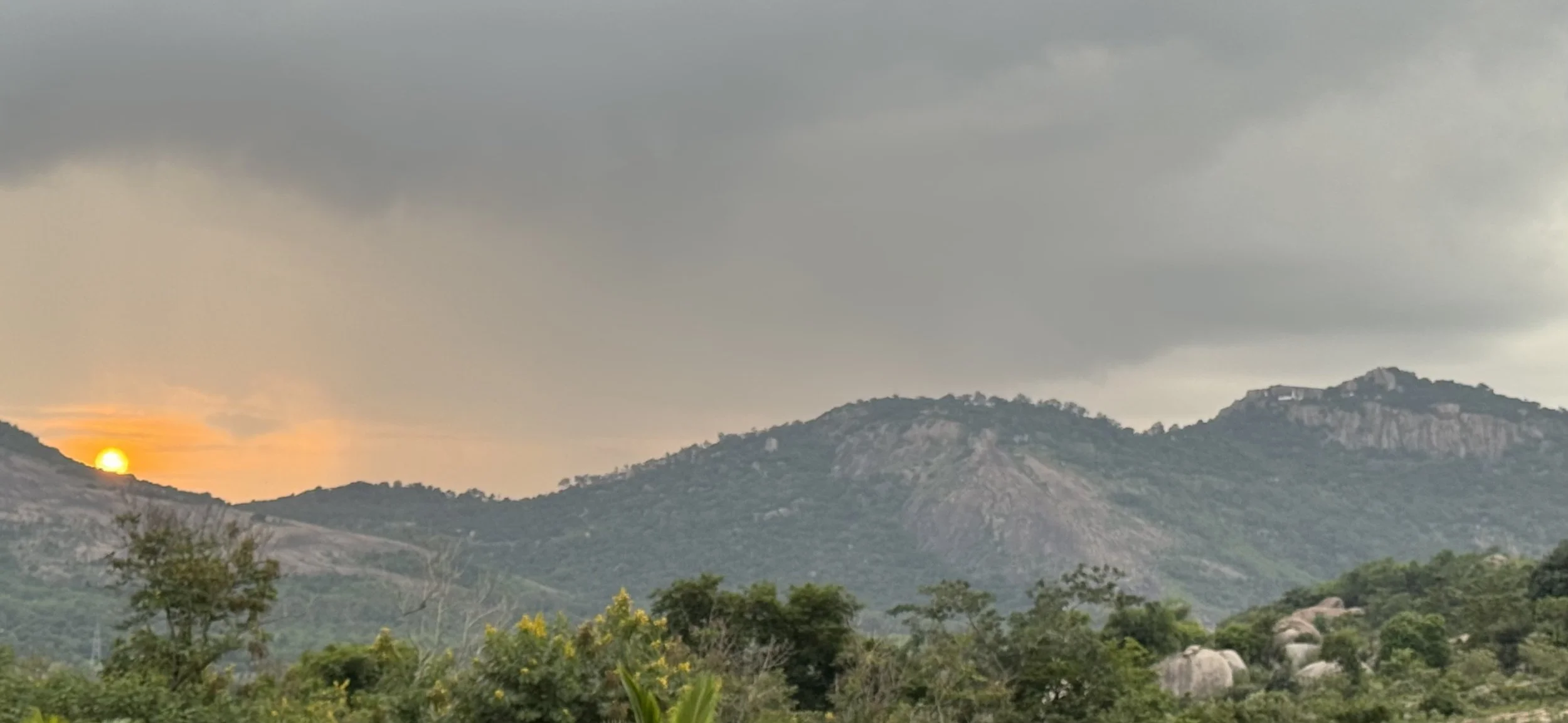
Just look at the photo… Can you see Lord Vishnu lying down? Is it just a coincidence that the Sun is setting at this feet? I believe not, we are truly blessed to live in this divine setting. This is the view of Devarayanadurga that we get on most days.
What did we plant?
Our farming philosophy is based on a minimal intervention method to create a sustainable dense agro forest. Our hope is that a selection of local hardy variety of fruit trees will lead to minimal use of water and improved soil structure over time. Based on this, here is the sample of the list of sapling varieties that were planted:
Canopy
Tamarind, Ice Apple, Indian Almond, and Jamun
Tree
Avocado, Bael, Sapota / Chikoo, Amla, Wood Apple, Cashew, Drumstick Tree / Moringa, Chironji, Kokum, and Apple
Sub-Tree
Chakota / Grapefruit, Guava, Custard Apple, Banana, Sweet Lime / Mosambi, Star Fruit / Carambola, Papaya, Fig, Water Apple, and Mulberry
Shrub
Pomegranate, Indian Plum, Karonda, Phalsa, Curry Leaf Tree, and Barbados Cherry
Yes, there are a few non-native trees, but they seem to have adapted to the local conditions. For example, did you know that Apple orchards were common in Bangalore? Read here.
Creating a fruit orchard our unique way
It all begins with an idea.
Do read our farming philosophy that is based on natural farming. The goal was to plant the saplings before the monsoon arrives. It was a race against time with barely 3 weeks to prepare the land, procure saplings, and plant them. Idea was to plant at least 30 varieties of native, hardy fruit bearing trees. After careful research. we decided on 32 varieties. Next step was to find a nursery that could get us those varieties. After talking to many fellow farmers we zeroed in on the nursery.
Land preparation started in earnest. As per our unique way, we did not want to do extensive ploughing, but basic shrub removal and pit digging had to be done. Unexpectedly, the land identified was very rocky and we could not go as fast as we expected. This slowed us down by 2 weeks. However, it was a blessing in disguise as the pre-monsoon rains stopped for 2 weeks. The initial plan was NOT to put irrigation as it was raining regularly. The stop in showers made it clear that irrigation line was definitely a pre-requisite. It was an experience to learn how to put a drip line, a story by itself, maybe for later.
Finally, with the pits dug and the irrigation drip line in place, it was time to procure the saplings and start planting! The big day arrived and booked a porter and transported the saplings from the nursery to the farm. With all the hard work done, it was relatively easy to plant the saplings.
It’s been a month now and they are growing quite nicely. Touch wood! Rains have restarted, and the babies seem to be enjoying their new home. Now it’s time to look after them and give them a healthy dose of jeevamruth every 15 days!